
"A highly advertised bonus is never an indicator of better mathematical value. When researching platform options, safety tools and transparent terms must take priority, followed closely by a clear understanding of the game rules and withdrawal policies." - Nisha Rao, Casino and Betting India
Last updated: July 2026
Online platforms have reshaped how people play poker. The focus shifted from reading physical tells to running quick math and learning software controls. Indian users face constant promotional noise pushing them to deposit right away. But understanding legal limitations, telling safe platforms from risky ones, and learning the structural logic of the game are steps you simply cannot skip before putting real money on the line. Current regulatory sources point to strict restrictions on online money games under the Promotion and Regulation of Online Gaming Act, 2025.
Evaluating any option means looking past surface marketing and doing a factual check of the platform, the terms, and your own budget plan.
What this guide covers: This article explains the basic rules of poker (including hand rankings and deal stages), walks you through choosing a platform, compares free vs real-money play, reviews Mostbet Poker honestly, and gives beginner strategy tips. Everything here is tailored for Indian players.
Disclaimer: Online gambling for real money may be restricted or prohibited in your state or territory. This article is for informational purposes only and does not constitute legal, financial, or medical advice. If you or someone you know struggles with gambling, please contact a qualified professional or a helpline such as the National Council on Problem Gambling.
What poker is and why players choose online poker
Poker is a competitive skill-based card game. It requires players to combine mathematical probabilities with strategic betting round decisions rather than relying entirely on random chance. Playing poker online attracts users globally for structural reasons: 24/7 accessibility, immediate game loading, and no need to travel anywhere.
The digital version mirrors the core rules of physical hands but speeds things up through automated shuffling and instant pot distribution. According to industry trackers like PokerScout, global online poker traffic maintains tens of millions of active accounts, with mobile devices accounting for roughly 72% of sessions as of 2023 (PokerScout, 2023 Industry Report). An observational study of actual online poker activity published on PubMed found that the median cumulative expenditure per player over two years was €439.7, with a median of 43 sessions. That tells us the majority of participants engage at a moderate level rather than as high-volume professionals (PubMed, Observational study of online poker activity. https://pubmed.ncbi.nlm.nih.gov/).
This shift toward digital means participation no longer demands proximity to a physical venue. The system manages chips, counts amounts, and controls the timer on every turn based on strict software logic. Convenience dominates player feedback across multiple regulatory surveys. Modern casino applications let participants jump into short matches from a smartphone, turning a time-intensive activity into something remarkably accessible.
Worth noting: even experienced poker players sometimes underestimate how different the online pace feels. The speed alone changes your decision-making rhythm.

- Blind:A mandatory bet placed before any cards are dealt to ensure there is money in the pot from the start.
- Fold:The action of discarding your hand and forfeiting any right to win the current round.
- Bankroll:The dedicated budget a player strictly sets aside for poker sessions. Think of it as your playing wallet, separate from living expenses.
- Tilt:Emotional frustration that causes a user to abandon strategy and make impulsive decisions.
- Pot Odds:The mathematical ratio between the current size of the money pool and the cost required to call a bet.
- Raise:To increase the current bet amount, forcing other players to match or fold.
- Call:To match the current bet to remain in the hand without raising further.
- Check:To pass the action without betting when no bet is pending, moving the turn to the next player.
- Bluff:Betting or raising with a weak hand to pressure opponents into folding stronger holdings.
- All-in:Betting all remaining chips in a single move, committing your entire stack to the pot.
- Showdown:The final phase where remaining players reveal their hands to determine who wins the pot.
- Dealer (Button):The positional marker indicating the last player to act in a betting round, giving an informational advantage.
How online poker differs from other poker formats
Digital gameplay delivers 60 to 100 hands per hour using validated algorithmic random number generators. Offline events physically process only 20 to 30 hands in the same timeframe (PokerStrategy, 2024). That difference alone changes everything.
When comparing online environments to other poker setups, the complete absence of physical observation fundamentally alters strategy. You cannot watch opponents tremble or hesitate. Strategy relies entirely on tracking betting patterns, statistical ranges, and timing adjustments. Digital platforms also let users access multiple tables at once.
Research into the structural characteristics of online poker identifies high hand frequency, multi-tabling, and round-the-clock access as structural risk factors that players should consciously manage (Griffiths et al., study on structural characteristics of online poker).
Multi-tabling is entirely impossible in a land-based room. Physical locations rely on human dealers, physical chips, and manual checks, which severely slows the flow. Software-based games also enforce strict time limits on every action, commonly known as a time bank, demanding that the poker player operates more quickly. Tracking software such as PokerTracker or Holdem Manager can overlay statistics on opponents in real time during online play. Offline poker simply cannot support that due to the absence of digital data.
Why poker players prefer playing online
Online participants overwhelmingly prefer internet platforms because the digital approach eliminates travel costs, supports mobile-first interfaces, and allows immediate entry into lower-risk limits.
The flexibility of playing online means a session starts and finishes on your demand. You do not wait hours for a table to open. A study from the Rutgers School of Social Work ("Internet Gaming in New Jersey") found that the majority of online players cite convenience, 24/7 availability, and the comfort of playing from home as the primary advantages. Instead of dedicating a full evening to a physical location, participants can spend twenty minutes examining board mechanics. Digital options also support micro-stakes limits starting as low as one cent.
This financial accessibility removes the intimidation factor created by high minimum buy-ins at physical establishments.
For anyone evaluating the iGaming market in India, finding local physical venues remains genuinely difficult. Shifting to an internet environment solves geographical isolation. The result? A much higher rate of casual daily exploration using mobile applications. I have seen players in smaller Indian cities mention that online poker was their first real exposure to the game, simply because there was no card room within 200 kilometers.
Poker hand rankings: the foundation every beginner must learn
Before exploring strategy or platforms, every new player needs to memorize the standard hierarchy of poker hands. Without knowing which combinations beat which, you cannot make informed decisions at the table. Below is the complete ranking from strongest to weakest:
| Rank | Hand | Description | Example |
|---|---|---|---|
| 1 | Royal Flush | A, K, Q, J, 10 of the same suit | A♠ K♠ Q♠ J♠ 10♠ |
| 2 | Straight Flush | Five consecutive cards of the same suit | 7♥ 8♥ 9♥ 10♥ J♥ |
| 3 | Four of a Kind | Four cards of identical rank | 9♣ 9♦ 9♥ 9♠ K♦ |
| 4 | Full House | Three of a kind plus a pair | Q♣ Q♦ Q♠ 5♥ 5♣ |
| 5 | Flush | Five cards of the same suit, not in sequence | 2♦ 5♦ 8♦ J♦ A♦ |
| 6 | Straight | Five consecutive cards of mixed suits | 4♣ 5♠ 6♥ 7♦ 8♣ |
| 7 | Three of a Kind | Three cards of the same rank | 7♠ 7♦ 7♣ K♥ 2♠ |
| 8 | Two Pair | Two separate pairs | J♥ J♣ 4♠ 4♦ A♣ |
| 9 | One Pair | Two cards of the same rank | 10♣ 10♠ 8♥ 5♦ 2♣ |
| 10 | High Card | No matching cards; hand value is the highest card | A♠ J♦ 8♣ 4♥ 2♠ |
💡 Expert Tip: Print or screenshot this table and keep it beside your screen during your first sessions. Most beginners lose money not because of bad luck, but because they misread the strength of their own hand. Seriously, it happens more often than you would think.
How a Texas Hold'em hand plays out (four streets)
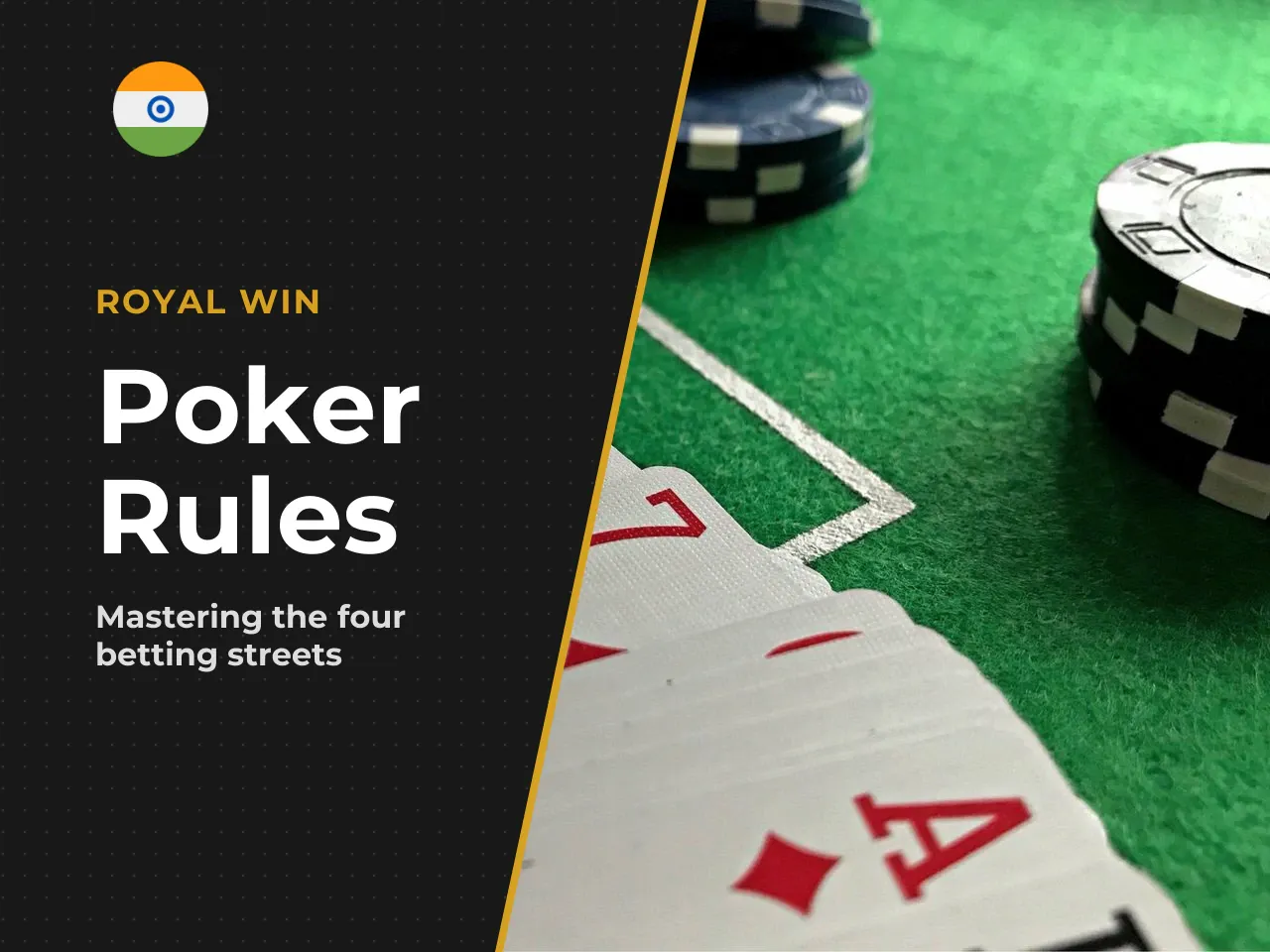
Understanding the four betting stages (also called "streets") of a single Texas Hold'em hand is essential before you sit down at any table:
- Pre-flop: Each player receives two private cards (hole cards). A round of betting follows based on the perceived strength of those two cards.
- Flop: Three community cards are dealt face-up on the board. Players now combine their hole cards with the community cards and bet again.
- Turn: A fourth community card is added. The pot typically grows larger as hands become clearer.
- River: The fifth and final community card is dealt. The last round of betting takes place.
- Showdown: If two or more players remain after betting, they reveal their hands. The strongest five-card combination wins the pot.
The entire hand takes between 30 seconds and two minutes online, compared to several minutes in a live setting. That compressed timeline is exactly why online poker demands faster mental processing.
How to play poker online step by step
Starting your digital session requires careful platform selection, completing mandatory registration protocols, deciding on a strict financial boundary, and filtering the lobby for a manageable game type.
Entering the software environment must happen deliberately. Many inexperienced users rush past identity verification, directly attempting to deposit funds. Most regulated markets implement strict frameworks to protect participants.
Regulated platforms are required to provide responsible gambling tools such as deposit limits, self-exclusion options, and player activity monitoring (Morgan State University, "Socio-economic Impact of Legalizing Interactive Gaming," 2024). For Indian players specifically, the key regulatory facts to understand are:

- Legality varies by state:Games classified as "games of skill" (including poker) are legal in most Indian states, but states like Andhra Pradesh, Telangana, and Assam have specific restrictions on online gaming for stakes.
- Tax obligations:Under Indian tax law, winnings from online games are subject to 30% TDS (Tax Deducted at Source) on net winnings exceeding ₹10,000 in a financial year.
- KYC is mandatory:Legitimate platforms require Aadhaar or PAN-based verification before enabling real-money play or withdrawals.
Every responsible user must set a definitive walk-away point long before considering a financial transfer. Playing safely means establishing identity clearance early to avoid blocked payout queries later.
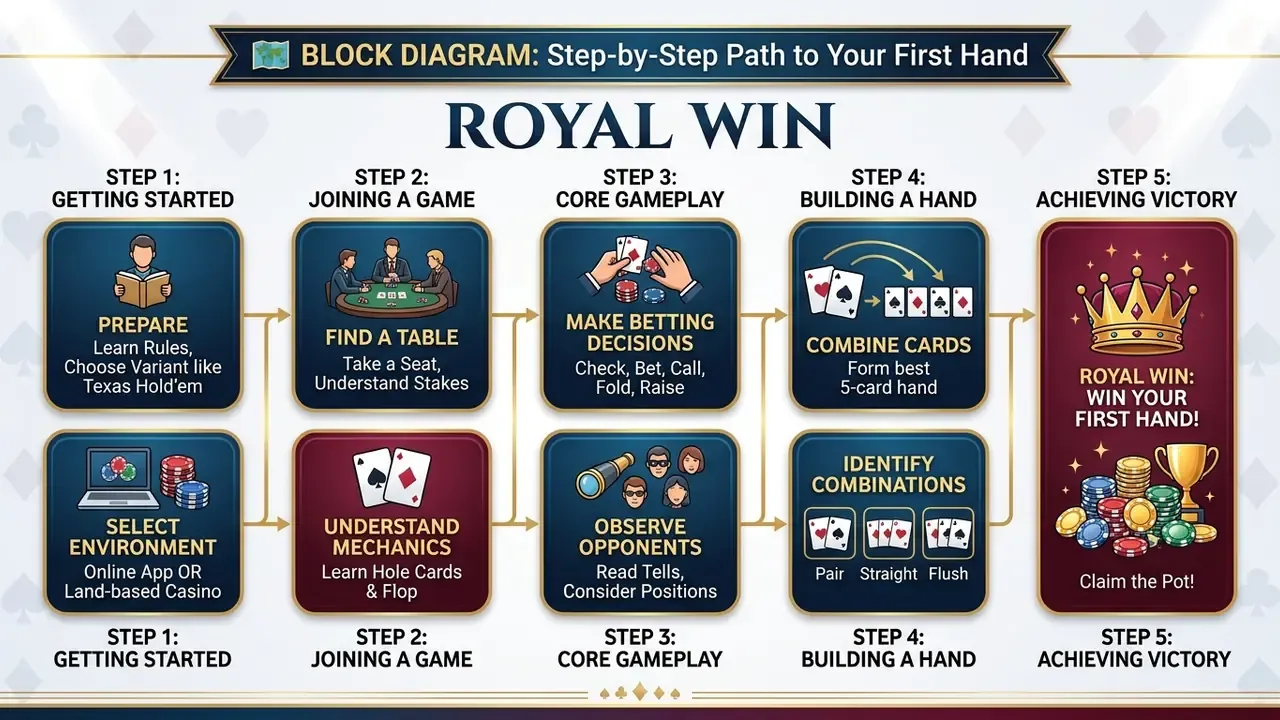
Alt text: "Step by step guide to play poker online securely."
- Choose an established poker room and check its licensing framework.
- Complete full registration and required identity checks (upload Aadhaar/PAN or equivalent).
- Make an initial budget-capped deposit or select a free entry tournament (freeroll).
- Filter online poker games by your preferred low stake and format (e.g., Texas Hold'em, 6-max).
- Join a suitable table and wait to receive your first hand.
Disclaimer: This information is general in nature and does not replace advice from a lawyer or responsible gaming specialist. Online gambling legislation varies by jurisdiction.
From registration to the first poker game
The onboarding flow spans from submitting basic identity documents, clearing initial compliance steps, navigating complex lobby parameters, to sitting at a defined digital table.
Software lobbies typically present massive grids of data that confuse new participants. Filtering is your absolute priority. A new user must locate the sorting tools to eliminate high roller tables. You filter to find formats holding six players, known as 6-max, and restrict the investment level to standard micro-limits. Once filtering is done, you select a seat and watch the software interface operate.
The system will automatically mandate a small initial bet if you land in defined positions, officially integrating you into the active round.
Players frequently encounter rejected payout requests due to incomplete documentation. Licensed operators are required to verify the age and identity of a player before granting access to real-money games (Morgan State University, "Socio-economic Impact of Legalizing Interactive Gaming," 2024). By submitting documents before moving any money, individuals secure an uninterrupted pathway. Failed verification friction drops significantly when you handle this upfront.
💡 Expert Tip: If you prefer fast payouts and fewer delays, always verify your KYC documents before your first deposit. Upload a clear photo of your ID and proof of address immediately after registration. This single step saves more headaches than any poker strategy ever will.

What a new poker player should know before playing
A beginner needs to realize that losing hands is a mathematically guaranteed part of the session. Avoiding financial desperation requires defining strict loss boundaries before opening the application.
The software will not protect you from your own aggression. Emotional regulation represents a primary defensive tool. When joining any online poker games, understand that the platform controls the speed, but you purely control the exposure. Before jumping into a cash cycle, a poker player is expected to understand standard hand rankings intuitively. Refer to the hand rankings table above. Taking time to memorize the hierarchy of combinations stops panicked maneuvers when the timer runs low.
Research into poker decision-making suggests that ambiguity aversion causes players to avoid situations with unknown opponent ranges, which can be strategically disadvantageous (Clark, "Common Ratio Effect and Ambiguity Aversion in Poker," 2024).
The gap between free testing environments and real options forces a shift in behaviour, making discipline the most defining trait of survival. Or to put it more bluntly: the game does not care about your feelings. Your bankroll management has to be stronger than your emotions.
Best poker games to start with online
The optimal format to begin your learning process is No-Limit Texas Hold'em. Its structural transparency reduces calculation difficulty while supplying widespread educational material across the internet.
When you navigate the top interfaces, the quantity of variations will seem overwhelming at first. The community widely splits into cash setups and scheduled tournament events. Cash tables offer the flexibility to quit after any hand. Tournaments require a dedicated block of time until you either accumulate all the chips or lose your entry fee. Selecting the proper starting variation significantly limits the rate of tactical errors. The simpler the deck management, the easier a participant understands fundamental logic.

Texas Hold'em as the easiest entry point
Texas Hold'em dominates the market because participants are dealt exactly two private cards, minimizing early combinations and making the integration with five shared cards logically transparent.
This specific framework requires less advanced calculation than alternatives with four or five starting components. In Hold'em, predicting what opponents hold becomes slightly more manageable. Texas Hold'em is the standard format used in academic studies of risk and skill thanks to its broad recognition among poker players worldwide (MIT, "How to Win at Texas Hold'em Poker"). Beginner participants start here because the action flows clearly over four defined betting phases: Pre-flop, Flop, Turn, River. You only track two personal cards.
The structural clarity ensures that anyone learning poker strategy easily finds dedicated guides evaluating standard Texas parameters.
There is a reason nearly every poker tutorial on the internet defaults to Hold'em. It is not because other poker games lack depth. It is because Hold'em offers the cleanest learning curve.

Other poker games worth trying after the basics
Progressing beyond foundational setups opens access to formats like Omaha and Short Deck, which drastically modify combination frequencies by altering starting card volume and total deck size.
In Omaha, the software distributes four private cards, but the rules force the user to utilize exactly two of them alongside three community pieces. The additional components increase the probability of someone holding extremely strong combinations. Short Deck removes all 2s through 5s, playing with only 36 cards. This structural change radically alters baseline probabilities. The reduced deck compresses card connectivity, making straights significantly more common than in a standard 52-card game.
Research on skewness preferences in online poker demonstrates that players exhibit a persistent preference for skewed payout distributions, choosing a small chance of a large win at the expense of expected value (SSRN preprint, "Skewness Preferences: Evidence from Online Poker," 2024-2025. https://ssrn.com/). This behavioral pattern helps explain why high-variance formats like Short Deck and Pot-Limit Omaha attract growing numbers of recreational players. By building understanding strictly on standard variations before testing 36-card mechanics, participants shield their bankroll from extreme volatility. Patience here genuinely pays off.
Poker hand basics and what determines winning poker decisions
A winning poker decision relies on comparing the internal strength of your cards against the statistical probability of your opponent holding higher values, heavily filtered by your seating position.
The core of playing poker successfully means recognizing when you face adverse math. You cannot guarantee a win. You can only make choices carrying a positive expected value over thousands of iterations. Behavioral psychology studies on gambling confirm that risk perception fundamentally alters strategic output. When players feel uncertain, they deviate from optimal lines. Ambiguity aversion frequently causes beginners to fold moderately strong combinations simply because they lack clarity on opponent tendencies. Mastering decision flows means discarding emotions and applying mathematical boundaries.

How a poker hand shapes each move
The calculated strength of the dealt components dictates your subsequent aggression, demanding that you formulate raising or folding patterns based purely on logical probability markers.
If you hold a pair of aces initially, strategy dictates an aggressive push to limit community participation. If you acquire unsuited, disconnected low figures, immediate folding protects the budget. Every community card dealt alters fractional strength. A strong pair on the flop often transforms into weakness if subsequent pieces complete flush potential for opponents. Realizing how the dynamic board texture shifts power helps the player understand exactly when passing is superior to paying.
Here is a small example that sticks with beginners: you hold pocket kings, the flop comes A-7-2. Suddenly your "great hand" feels fragile. That shift in confidence? That is board texture at work. Your hand only holds value entirely relative to the visible elements on the board.

Simple poker strategy for more consistent play
Consistent performance requires executing disciplined routines like adhering to Tight-Aggressive opening charts, utilizing late table seating, and completely avoiding low-probability chases.
Modern educational content divides beginning approaches into distinct play styles:
- Tight-Aggressive (TAG):Only participate in 12-15% of opening deals, heavily leaning on raising rather than merely matching bets. This is the most recommended style for micro-stakes beginners.
- Super-Tight (STG):Drop participation to less than 10%. Ideal when learning bankroll discipline and patience.
- Loose-Aggressive (LAG):Open 20-25% of hands with aggressive three-bets. This style is generally considered too risky for newcomers at micro-limits.

The goal in all cases is removing the possibility of playing marginal options out of position. Research on skewness preferences shows that players systematically sacrifice expected value for skewed distributions, a behavior incompatible with classical utility theory ("Skewness Preferences: Evidence from Online Poker," SSRN preprint, 2024-2025. https://ssrn.com/). Understanding pot mathematics means you calculate whether the potential payout reasonably justifies the immediate cost. Never pay incorrectly for missing pieces.
If there is one poker strategy principle to tattoo on your brain, it is this: position plus patience beats talent plus impatience almost every time.

Why Mostbet Poker is considered before you play now
Mostbet Poker generally garners attention because it integrates directly into an overarching betting catalog, features micro-limits designed for casual entertainment, and runs periodic zero-cost tournament entry options.
When searching for new avenues, you encounter brands blending casino suites with digital tables. Mostbet Poker relies on the IPoker network architecture, ensuring functional software stability but historically attracting casual participants rather than specialized professionals. It lacks native integration for comprehensive tracking databases like Holdem Manager, which effectively pushes away high-volume analytical players. While looking at offshore offerings in India, evaluating legitimate standing remains tough. The platform functions around Curacao betting licensing structures (license GLH-OCCHKTW07070707). However, primary regulatory resources do not officially publish data tracking specific poker platform parameters separate from the main brand. None of the available academic sources from 2023-2026 contain verified data on gaming outcomes or the safety record of Mostbet Poker specifically.
| Feature Category | Mostbet Poker Trait | User Impact |
|---|---|---|
| Interface Complexity | Stripped down, single-view lobby | Allows beginners to start navigating simply |
| Pacing and Limits | Stakes start at $0.01/$0.02 | Minimizes financial exposure for casual sessions |
| Promotional Entry | Routine freerolls with low caps | Provides lower-risk testing environments |
| Software Support | No external tracking software compatibility | Keeps professionals away but removes advanced user analysis |
| India Legal Market | Operates as offshore entity under Curacao license | Carries typical offshore compliance and jurisdictional restrictions |
| Deposits (India) | Accepts INR via UPI, Paytm, bank transfer, and crypto (BTC, USDT) | Familiar payment methods for Indian users |
| Minimum Deposit | Approximately ₹300 (~$3.50 USD) | Low barrier for cautious beginners |
| Withdrawal Time | Typically 24-72 hours depending on method and KYC status | Plan ahead; verify identity before first deposit |
Disclaimer: This information is general in nature. Mostbet Poker operates as an offshore operator; in India, real-money online gambling is regulated at the state level and may be restricted. Please verify the current legal status in your jurisdiction before registering.
User Review: "The micro-stakes tables on Mostbet feel soft for beginners, good for learning without pressure. Withdrawal to UPI took about 48 hours after my KYC was already approved." - Based on aggregated player feedback from gaming forums.
What users look for in Mostbet Poker
Casual visitors evaluate this option searching for stripped-down lobby mechanics, friction-free movement from main casino balances to table limits, and immediate access to low-barrier events.
The typical participant investigating this brand is not a professional preparing for ten-hour grinds. They are entertainment seekers. They require clear buttons, readable table displays, and options that run natively inside standard browser windows. They look at freeroll pools hoping to test platform stability without immediate budget depletion. Software lacking extreme data complexity actually benefits early adopters who feel intimidated by professional platforms.
The design explicitly caters to basic usability rather than comprehensive statistical tracking.
One thing I have noticed in forum discussions: players who come from mainstream casino apps tend to find Mostbet Poker's interface familiar. That familiarity reduces the learning curve, even if the poker-specific features are not as deep as standalone poker clients.
When Mostbet Poker fits beginners and regular players
The environment comfortably fits absolute newcomers seeking relaxed micro-stakes testing, whereas experienced regulars typically avoid it due to restricted software transparency and the absence of high-tier traffic volumes.
Because advanced mathematical tools do not sync with the client, individuals relying on vast databases of opponent tendencies find the tables inefficient for professional volume. A beginner strictly benefits from this exact scenario. Without analytical programs dissecting every tiny move, casuals play against other casuals relying purely on fundamental knowledge. However, relying on offshore sites introduces friction. Regular withdrawal checks remain somewhat tedious. Professional volume demands airtight, deeply regulated jurisdictional safety, which dedicated standalone networks traditionally highlight better than integrated cross-platform modules.

Fact Check summary: Promoting rapid "play now" environments often obscures reality. Official documentation regarding Mostbet's distinct poker terms, specific poker bonuses, and conditional wagering demands lacks transparency in primary academic searches. Users should expect standard terms associated with IPoker networks. Entering any free or budget-linked format strictly requires users to pass standard Terms and Conditions. Indian participants must realize that offshore play lacks domestic legal recourse.

Free poker vs real play: which format to choose
Choosing between virtual currencies and actual balances depends on immediate goals. Zero-cost testing successfully outlines button mapping, whereas actual deposits establish necessary psychological risk awareness.
The jump between testing and monetary participation forms the most difficult gap in digital card activities. Virtual testing carries zero stakes, eliminating genuine human tension. According to professional figures analyzing competitive behavior, participation in risk-free brackets involves individuals pushing chips recklessly due to missing financial consequence.
A study of practice modes on gambling sites found that some platforms offer unrealistically high returns in free play and encourage users through pop-up messages that do not carry over to real-money games (Frahn et al., study on practice modes in online gambling, ScienceDaily).
Conversely, placing even fractions of a dollar immediately activates psychological caution. Genuine financial lines significantly elevate cognitive load and emotional response rates, fundamentally altering betting methodology across the entire table. This is why experienced coaches universally recommend transitioning to at least micro-stakes as soon as the interface feels comfortable.
When free poker makes more sense
Utilizing non-monetary participation serves a clear purpose when you actively need to observe interface behavior, check basic connection stability, and physically practice identifying correct hand layouts.
Entering a zero-cost scenario allows absolute mistakes without punishment. You verify whether the platform accurately registers your clicks in time. Educational resources heavily promote using virtual testing expressly for memorizing the difference between a straight and a flush. It prevents interface unfamiliarity from costing you real money. However, Frahn's research suggests these practice modes sometimes deliver statistically inflated returns.
If you continually win massively on fake tables, do not assume those results directly mirror monetary conditions. The environment simply operates differently.
Research reviewing adolescent internet gambling indicates that participation in free modes correlates with subsequent real-money gambling, though a definitive causal link has not been established (Review of adolescent internet gambling, academic literature). This is an important consideration for younger or inexperienced users who may underestimate the transition gap.
Where to find free games: Look for "freeroll" tournaments in the poker lobby (Mostbet runs these regularly), or use the "play money" toggle available on most major platforms. Some apps also offer standalone demo modes for practice. These are genuinely useful for building confidence before risking real funds.
When real play becomes the better option
Moving toward actual balances proves necessary when interface controls feel completely familiar, because only strict financial consequences correctly discipline an individual into applying tactical folding strategies.
When a user sits at a micro-limit table betting cents, opponents largely cease pointless, illogical raises. The existence of tangible loss fundamentally alters group dynamics. The table math becomes significantly more reliable. The PubMed observational study of actual online poker activity found that the median deposit over two years was €176.4, confirming that most players start with cautious, modest amounts rather than large sums (PubMed, Observational study of online poker. https://pubmed.ncbi.nlm.nih.gov/).
Beginners often overestimate real-play capacity because they crushed fake lobbies. Professional quotes consistently highlight that bankroll management concepts mean absolutely nothing until your personal wallet feels the fluctuation. Moving to micro-stakes delivers more realistic training than months of virtual chip hoarding. The discomfort of losing even ₹50 teaches lessons that no tutorial video can replicate.
Tips for playing poker online with fewer mistakes
Mitigating costly errors demands that you lock session durations, strictly limit the number of active matches on your screen, and systematically implement protective money constraints.
Without internal regulation, the software operates infinitely. Building boundaries isolates your capital from cognitive fatigue. You must physically walk away. Practical guidance found across digital gaming therapy resources advises cutting off engagement strictly after encountering several rapid losses, a state generally recognized as "tilt." This approach ensures logic dictates actions, not the desire to chase back previous drops. If exhaustion occurs, the likelihood of incorrectly reading the board increases dramatically. Protecting funds relies heavily on protecting attention spans.
To illustrate the risk of unchecked escalation: the PubMed observational study found that the top 1% of players by spending had a median cumulative expenditure of €272,581 and over 1,149 sessions in just two years. That is a stark contrast to the typical profile (PubMed, Observational study of online poker. https://pubmed.ncbi.nlm.nih.gov/). Setting firm personal limits is the clearest way to avoid drifting into that extreme.
Easy habits that improve online poker sessions
Committing to rigid one-hour windows, completely turning off external messaging distractions, and limiting your focus to a single display screen drastically heightens overall performance consistency.
Habitually starting play fully rested minimizes bad choices. Another heavily recommended routine relies on the "20-30 rule," suggesting an individual never attempts a limit unless their wider wallet holds twenty to thirty times the required entry. While this figure acts as a subjective community heuristic rather than absolute scientific law, it effectively cushions an account against inevitable statistical downswings.
Additionally, intentionally slowing down response times by utilizing the allocated timer stops impulsive calls governed by frustration.
A small personal observation: the players who consistently perform well at micro-stakes are not the ones with the fanciest strategies. They are the ones who log off when they are tired. Discipline beats brilliance at these levels.
🎯 Pre-session checklist for beginners:
- Internet connection is stable (wired or strong Wi-Fi).
- All distracting apps and notifications are turned off.
- Bankroll holds at least 20 buy-ins for the chosen stake level.
- A strict time limit has been set (e.g., 60 minutes maximum).
- You are rested, fed, and in a calm mental state.
Mistakes new poker players repeat most often
Inexperienced individuals continually enter matches playing over thirty percent of their dealt cards, utilize passive calling without showing defensive aggression, and routinely fail to leverage the late dealer position.
Mathematical breakdowns heavily criticize a broad range requirement. You cannot win reliably throwing money at every two randomly dealt cards. Passive playing, frequently referred to as being a "calling station," completely removes the vital option to win pots prior to the final phase. Instead of raising to apply pressure, beginners simply pay to look at the next card. Furthermore, entirely ignoring the positional marker indicating the last actor on the table destroys potential expected value.
According to foundational texts covering positional theories, acting last provides total informational superiority over the rest of the table.
Research into the persistence of performance in online poker confirms that experienced players demonstrate consistent profitability over large sample sizes of hands, proving the significant role of skill rather than pure chance ("Beyond Chance? The Persistence of Performance in Online Poker," academic literature). This means that fixing these common leaks, including wide ranges, passivity, and positional ignorance, produces measurable long-term improvement.
Top 5 beginner mistakes at a glance:
- Playing too many hands (VPIP above 30%).
- Calling instead of raising or folding ("calling station" syndrome).
- Ignoring table position, especially undervaluing the dealer button.
- Chasing draws without calculating pot odds.
- Playing while tired or emotionally tilted.
FAQ about poker online and Mostbet Poker
Respuestas renderizadas en formato acorde al diseГ±o exportado: tarjetas oscuras, acento dorado y despliegue compacto.
1 Can beginners start with Mostbet Poker right away?
Can beginners start with Mostbet Poker right away?
Yes, beginners can functionally configure an account and launch zero-cost events (freerolls) immediately. However, engaging in real-money transfers requires passing all baseline identity and geographic eligibility hurdles first.
Mostbet operates globally, restricting usage firmly to adults aged 18 and older. While the interface opens testing environments rapidly, do not expect to slide into money brackets without submitting verification checks. The offshore licensing structure creates compliance protocols determining processing pathways. Entering instantly feels appealing, but pushing through without evaluating terms, regional blocks, and basic operational limits frequently leads to locked profiles.
2 Is online poker legal in India?
Is online poker legal in India?
The legal status depends on your state. In most Indian states, poker is classified as a "game of skill" and is not prohibited. However, states including Andhra Pradesh, Telangana, Assam, and Nagaland have specific restrictions. Offshore platforms like Mostbet operate outside Indian jurisdiction, meaning there is no domestic regulatory recourse if disputes arise. Always check your state's current laws before depositing. This is not optional advice; it is a necessary step.
3 Does Mostbet Poker support UPI and INR?
Does Mostbet Poker support UPI and INR?
Yes. Mostbet supports deposits and withdrawals in INR via UPI, Paytm, net banking, and several cryptocurrency options (BTC, ETH, USDT). The minimum deposit is approximately ₹300. Withdrawal processing typically takes 24-72 hours once KYC verification is complete.
4 What should you check before you play now?
What should you check before you play now?
Always check the local jurisdictional reality of playing online environments, verify the explicit availability of localized payout methods, and carefully read the precise withdrawal parameters before clicking deposit.
Do not drop cash onto a site that obscures its terms. Examine the responsible gaming tools actively available on the platform dashboard. Can you manually lock your own deposits? If a site completely avoids implementing time limits or cash caps, you stand at higher risk. Users attempting to pull funds from unregulated domains often face absolute silence.
Licensed operators are required to publicly disclose data on gaming activity and financial transactions to their regulator, providing a baseline level of player protection (Pennsylvania Gaming Control Board, Interactive Gaming Reports FY24-25). When evaluating offshore options like Mostbet, the absence of such mandatory reporting should factor into your risk assessment.
By crafting explicit pre-deposit workflows targeting UPI verification pathways, participants managed to avoid severe blockages, ensuring their accounts passed KYC clearance well before pushing their initial chips into the center. Safety protocols ultimately carry more weight than any presented digital bonus.